

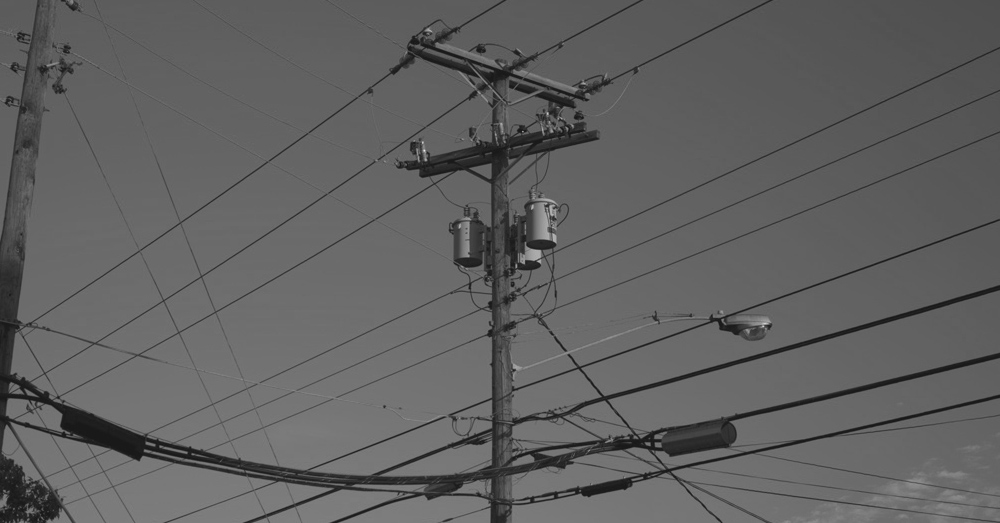
If you’re anything like me, you’ve driven, walked, flown over, circled around, narrowly avoided crashing into one of the most ubiquitous examples of modern engineering and convenience ever made: the telephone pole. Also known as a utility pole which is a more accurate name in the present day, as these tall wooden structures do a lot more these days than simply transmit communication signals from point A to point B. But while you vaguely know that these have something to do with how we are able to easily use the phone, have electrical appliances, and watch cable television, do you know what all those crazy looking metal bits and bobs and multiple wires all specifically do?
I didn’t until I finally decided to learn for myself, and soon enough, you’ll know too.
The more historically-minded among you can probably guess when and why the first telephone poles came into existence, and you might even know that they of course wouldn’t have been called telephone poles at all. Yes, their origins harken back to a time before telephones – or even any form of communication faster than “snail mail” – existed. At their debut in the mid-nineteenth century they were called telegraph poles, and were used by a variety of clever engineers (among them telegraph and Morse Code pioneer Samuel Morse, of course of course) to transmit text messages using electrical signals sent through extremely long wires. Funnily enough, the original plan for telegraph wires was for them to be buried underground, however thanks to some defective wire insulation accidentally sabotaging Morse’s planned demonstration for Congress he had to quickly come up with a plan B. This plan was to cheaply build a series of poles to string the telegraph wires along. The test was a historic success, and the fate of American railways, roads, and highways was sealed. Never again would a citizen be able to drive more than 100 feet on a road without seeing long cables stretching across the horizon.
Fast-forwarding to today, we no longer use the telegraph. However, the infrastructure built by the engineers of the past still remain, repurposed into the utility pole.
The modern utility pole is a 35 foot tall, 1 – 2 foot diameter cylinder usually made from decades old fir or pine trees. You may have seen some variants made from steel or even concrete, and possibly even very tall poles ranging up to 100 feet, but those are generally for more industrial, heavy duty power transport. The kind you see every day outside your home, workplace, or favorite shopping haunts are generally all the same imposing wooden posts, maybe adorned with some horizontal bars at the top.
But the interesting part of utility poles to me is not the poles themselves, but instead the things that are placed on the poles. Crazy steel spirals, big cylinders with small wires running off them, thick black tubes hanging off the sides… what do those all do?
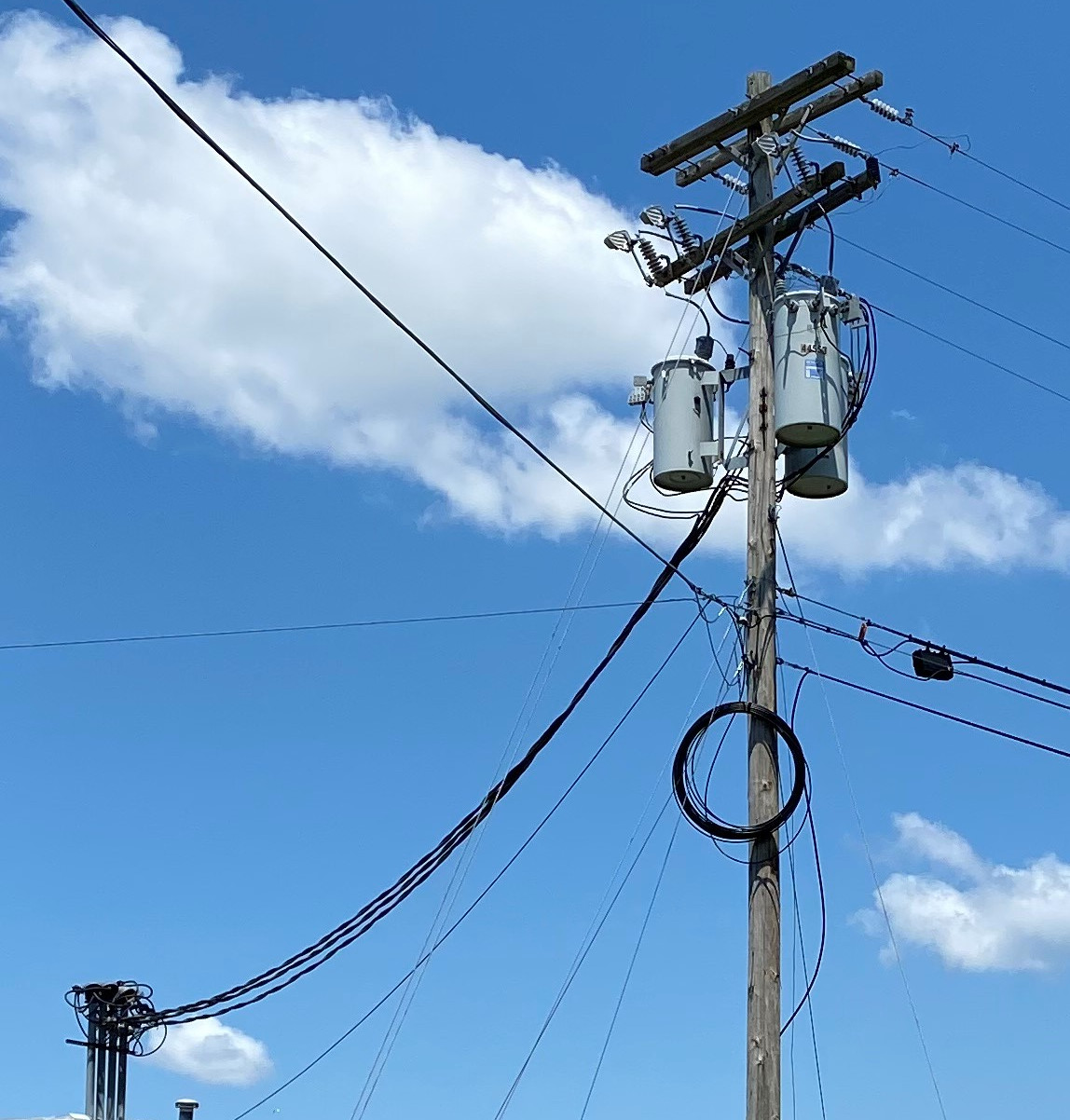
Well let’s start at the top, because all the most fun (i.e. most dangerous) stuff is up there. This is by design – the most hazardous parts of the pole are kept as far from the ground – and potential human contact – as they can be. The upper part of the pole is called the supply space because that is where the electric supply lines live.
The horizontal bar at the top of some poles is called a cross arm. These arms support several large wires called primary lines. Primary lines are the workhorses of the electrical supply – they carry power at blisteringly high voltage – anywhere from 4,000 to 34,000 volts. They are usually made out of copper, or else steel encased in highly conductive aluminum (source).
Underneath that on many poles is a thick cylinder called a transformer, which has one very simple but important function. It converts the crazy high voltage electricity carried by the primary lines into much more manageable voltage, the kind our appliances and electronics like to use. A transformer is required any time the power needs to get off the pole and into a house or business. Sometimes a transformer will lower the voltage and then send it over many utility poles which do not have primary wires – you’ll see these often in residential areas, connected to every house. This requires a second set of low voltage wires that you’ll typically see underneath the transformers – aptly named secondary lines. These wires carry voltages between 120 and 280 volts – much smaller than primaries. Mixed in with the secondary lines is a grounded neutral conductor line to provide path for the electricity to return to the power station.

The transformers also have cool little things attached to them called lightning or surge arresters. These things are basically powerful surge protectors that prevent massive influxes of power from overloading the transformers – the kind caused by unlucky lightning strikes or even the transformer hardware going haywire.
They are designed to divert power surges into the ground rather than the transformer, thus preventing it from damage while also keeping the power levels going to your home or workplace constant. That means less chance of a power outage! Here is a cool video I found that explains a little more in detail exactly how an arrester works, and what’s inside that mysterious stacked disc shape.
Underneath the secondary lines is where the telephone and cable wires go. These are far less dangerous than the electrical wires above and therefore they do not reside in the supply space – they inhabit their own area called the communications space. These don’t pose much of a threat to people – if you touched one while also being grounded, it wouldn’t be enough to seriously injure you. These cables usually only have around 50 volts running through them. Here is a link to a simple interactive diagram that show the separation of the sections of a utility pole.

Hanging on all these wires are black boxy objects. These are easy to explain: The cables carried by telephone poles are not infinitely long – or actually very long at all when compared to the length they need to be to run across towns, cities, and states. Multiple rolls of cable need to be spliced together in order to function as a single continuous wire. These black boxes are weatherproof enclosures that house the numerous cables and wires at their terminating point, providing a central location for joining a new roll of cabling to others, while allowing easy access for repairs and adding new splices if necessary.
Now for the very bottom! One of the most common parts of a telephone pole is a wire coming off it at about 60 degree angle, sometimes covered in a distinctive yellow jacket. For the longest time I thought it was a ground wire, to direct any excess electricity down safely into the ground instead of into an unsuspecting animal or human that might accidentally touch it. That ground wire does exist, however it is a thin wire than is directly attached to, and runs down the entire length of, the telephone pole. So what is this other cable then?
It’s known as a guy wire and its sole purpose is providing additional support for the utility pole. It helps keep the pole – which is also set six feet into the ground – upright during high winds. That’s all! It’s not energized and isn’t used for conducting electricity. The yellow plastic that surrounds it is primarily for visibility, to ensure people don’t walk or cycle into it. However, there have been cases where the ground wire wasn’t properly grounded, and thus the guy wire became the path of least resistance for excess charges, resulting in human injury, so… in the end, like everything on a utility pole, it’s best to leave the guy wires alone.
That wraps up our anatomy lesson! After years of being curious about the elements that make up telephone poles I finally dug into them, and I’m glad I did. It’s amazing to me how these ex-trees so quickly dominated our landscape, and how essential they now are to our lives. I don’t consider them an eyesore like many do, though I can’t help but wonder if things would be different had Samuel Morse been able to prove the viability of underground wires when this technology was just beginning to appear…
###
Hungry for more information on utility poles? Check out this great PDF made by American Electric Power that presents the sections in a visual, easily digestible format!


Backstreet’s back! Wonderful post (as always). Keep ’em coming! I really enjoy your pov.
LikeLike