My interest in architecture began quite a while ago. Long before I became interested in urban exploration, long before I studied all the amazing buildings designed by my favorite architect Frank Lloyd Wright, all the way back to a time where I was still building towering structures out of Lego.
By no means am I a savant when it comes to construction, design, and architectural beauty but I know enough to be dangerous. There was a point in my life where I would check out David Macaulay books from the library and pore over the details of every object within, marveling at the ingenious ways humans have created wonders so much grander than the mud huts we started out with. Over time, I developed quite the discerning palate as to what styles I found pleasing and what deserved to never again resurface.
For those wondering (if the current header of my blog didn’t give it away), my all-time favorite architectural style, something that may even merit an extensive post of its own one day, is Art Deco. An early twentieth century movement that inspired many of the incredible skyscrapers found in New York that are to this day widely renowned for their beauty. My second favorite style, a close one, would be Gothic. Medieval churches simply cannot be outmatched in terms of grand scale, mechanical ingenuity, and the sheer dedication to creating something awe-inspiring that their creators had.
Those two movements are commonly held to have resulted in the most beautiful building the world has ever seen, so it’s no surprise that they top my list. I’m not entirely an aesthetic conformist though. There’s a third style that never fails to interest me, one that few would dare to say can stand even in the same ring as the two I just mentioned. Many would say it is the ugliest blemish on the face of the Earth since the birth of Mick Jagger. It is known as Brutalism.
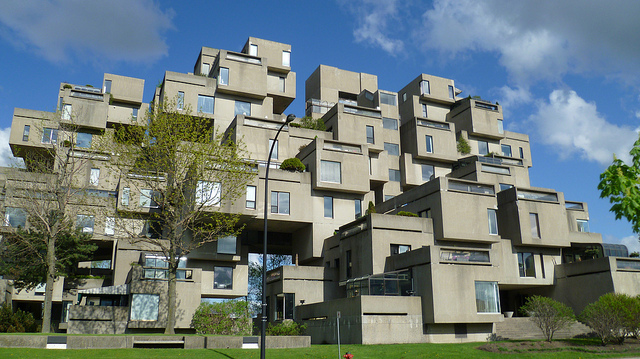
Brutalism is the spawn of a war torn Europe. Following the decimation of countless civilian homes, businesses, and institutions there arose a need for these things to be resurrected as quickly, and as cheaply, as possible. What could be cheaper than unpainted concrete? What could be cheaper than mass-producing boxes made from the stuff, a one-size-fits-all solution to building structures with a wide variety of use? Thus Brutalism became the preeminent style for much of the two following decades, before falling into disregard as being truly hideous and loathsome.
The way the name came about is something that has a little bit of debate surrounding it, but it’s also not particular interesting so I’ll only touch on it briefly. Apparently a Swedish architect used it to describe a house designed by some of his fellow craftsmen, and the term caught on to describe the new wave of architecture defined by sharp angles and striking simplicity. Though this is widely considered the beginning of the term, I find it interesting that the house the architect was talking about, Villa Göth, was made of brick and had a regular triangular roof, two things which are an exception, rather than the norm, to the Brutalist style.
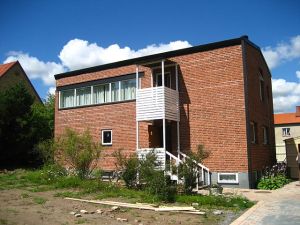
Personally, I wouldn’t call it Brutalist at all. Just because it’s a bland square does not allow it to take on the mantle. Another theory is that the name comes from the French words for raw concrete, “béton-brut”. Concrete itself is the defining material of Brutalist architecture, but this also seems a bit too convenient and far-fetched to me to be the answer. However, the truth may very well be that one or both of those terms were the genesis of the name- but it doesn’t matter. Either way, let’s get back to the main focus of this article: crazy buildings.
Origin of the name aside, it can’t exactly be said that Villa Göth is Brutalist in nature or design. So what would early examples of real Brutalism be? Well, there is one building, or more accurately a series of almost identical buildings, that are considered to be the definition of early Brutalism. Even today they are held up as a prime example of its raw and striking style.
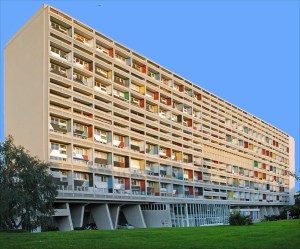
Built by the French architect Le Corbusier in the fifties and sixties, the buildings known simply as Unité d’habitation were made to be cheap, working-class housing for families displaced after World War II. Steel proved to be too expensive to use for its frame and thus Le Corbusier turned to the inexpensive béton-brut as a suitably strong and reliable replacement. Initially completing construction of the first one in Marseilles, 1952, he saw four more arise over the next decade. “Le Corbusier thought that high rise buildings could be used to create spacious city homes with the same amenities as a typical street” (source: dezeen.com). It was this design that inspired other architects to experiment with concrete as a medium for stripping down structures to their essence to provide new, exciting ways to build functional and cheap works of art. The important things to notice about Unité are its colorless concrete, lack of any curves, and small, claustrophobic windows.
To interject my own thoughts for a moment, while researching for this post I found a surprising lack of articles and architects talking about Brutalism’s clear Soviet influences. All sources point it out to be a style dominated and defined by French and English artists, which to me is crazy when you look at the communist buildings in formerly USSR controlled territories. To be fair, they are mostly built in the 1970s and 80s, so the builders weren’t early adopters or ones who defined the style. It wasn’t easy to find the names of the Soviet architects who built them either, which may be due to the culture of the country at the time. Perhaps you weren’t allowed to take credit for your own work in Russia unless you were a murderous dictator. Even so, I think that Russia was the country that most fully embraced Brutalism and poured out some of the most iconic and definitive works related to it. Observe:
(Annoyingly the only picture or even reference I could find to the super-cool Het Poplakov Cafe was that image in various design articles. I’ll trust that it’s real though.)
Going back to the famous Brutalist artists, Le Corbusier’s work became popular with his contemporaries, and many British architects decided to take the style and run with it. A pair of British architects, dynamic husband and wife duo Peter and Alison Smithson, latched on to the crazy new theme and took it to new heights. Once again, the recent war had a huge effect on them as well. The New York Times Style Magazine stated “For a world still climbing gingerly out of the ruins of World War II, in need of plain dealing and powerful messages, this brand of architectural honesty was refreshing” (source).
The Smithsons created some remarkable buildings, as they were very talented architects who caught the eye of critics and communities early in their twenties. They designed stripped-down and simplistic modernist buildings – like the Hunstanton School (still in existence today as a high school), an early work which foreshadowed the direction that they would continue to take with their art.

While even I have to admit it’s pretty bad, it was a huge success at the time and a springboard for the Smithsons’ careers. As their business continued to expand, it was evident that they were not only inspired by Le Corbusier but they also were helping to define the intrinsic principles of the emerging Brutalism.
Their career did not have a fantastic end, sadly. In the 1970s they built a housing complex that they hoped would successfully “combine the community of the Victorian slums with the efficiency and density of Le Corbusier’s housing blocks” (source: archdaily.com). Unfortunately the building had numerous structural problems and maintenance issues, and was recently completely demolished in favor of a new wave of housing. The fact that it fostered a high amount of crime due to the location and poverty of its residents only served to further harm its image, which is all it took for the public to lose faith in the Smithsons. Nevertheless they were absolutely instrumental in shaping and defining the Brutalist style. There were many other excellent artists similar in vision to Le Corbusier and the Smithsons, but for brevity’s sake I will encourage you to look up some of them on your own if you want to learn more about the brains behind the Brutalist buildings: Walter Netsch and Gottfried Böhm have some interesting work.
Now after all that, you would expect this style to have died a quiet death, buried deep in the ground at a funeral ceremony no one went to. And you wouldn’t be wrong for expecting that. Vilified for so long, Brutalism was believed to have no place in the portfolios of modern, progressive architects. Like Millard Fillmore, its reign was short and unremarkable, dying around the 70s or 80s, depending on who you ask.
Interestingly enough, however, in recent years there has been something of a revival of appreciation for the style. Many of the remaining Brutalist buildings still in use are getting to the age where the question of renovation or even demolition comes up. Brutalist monuments and statues, long left to decay, are now seeing individuals stand up and claim that they should be properly maintained and preserved as relics of an important time period in art history. “Preservationists clamor for their survival, historians laud their ethical origins and an independent public has found beauty in their rawness.” (source: nytimes.com).

While it is still rare to see the style even have a hint of influence in modern architecture, and we may never again see new works outside of avant-garde artists looking to be different, I think the fact that people having an open mind to the potential beauty of Brutalism is enough. It gets a lot of hate when in truth it was a very daring departure from the traditions of its time, and not a bad one at that. I have often found myself starting at crazy looking, absolutely one-of-a-kind buildings with great interest and wonder. Invariably, these are Brutalist in nature. As I mentioned before, they may not have the celestial beauty of Gothic churches or Art Deco monuments. But in my opinion, no buildings vary so much in design while working with such a small variety of materials, as Brutalism. Fortunately, others agree and wish to preserve these artworks. As the New York Times so excellently puts it: “Architectural fashions go in and out of style with disorienting alacrity. What is one era’s style is the next era’s eyesore, and in the midst of a demolition binge, a new generation learns to appreciate, often too late, what is disappearing” (source).
My interest in Brutalism mirrors its rebirth from the ashes of the late 20th century. When I first saw the style, without knowing its name but knowing it was related to ugly utilitarian Soviet designs of yesteryear, I had no use for it. Its in-your-face presentation clashed horribly with the muted and humble plain concrete bones, and I had no use for it. All the buildings looked the same, they were all boring, and lacked any of the creativity and majesty you could find in beautiful churches and towns built centuries earlier. How could we have taken a step, or maybe even several jumps, backward? Clearly the architects were just trying to be innovative and counter their fellow artists who were focused on decoration, facades, and form-over-function.
Well that may have been the case, but it was also the case that my opinions changed as I learned more about Brutalism and saw more examples of the style. It slowly began to intrigue me how easily identifiable the style was. No matter how crazy the building, no matter if it was a vast city hall or a small set of statues, the unmistakable simplicity of design and plain béton-brut instantly gave away their inspiration. I realized that there is a vast variety of ways architects expressed themselves by using this incredibly honest style. And suddenly I realized I didn’t mind it so much.
I can’t say I find the style ugly. Like everything, I believe it has a proper place and utility. Some things, like churches, town halls, and playgrounds should never be Brutalist. However, skyscrapers, office buildings, and housing complexes can make exceptionally good use of the style. Some visionaries can push the style beyond its limit and create some truly attractive pieces like the earlier shown Habitat 67. I would hate for the style to disappear altogether so I am glad it is seeing a small revival.
It’s not hideous. But I can’t say it’s beautiful either. A dilemma. How can a style not be ugly but not be attractive either? Well that attribute is something I find unique to Brutalism. It’s plain, open, and is an unpretentious expression that exudes the phrase “what you see is what you get.” I find it refreshing, and while I wouldn’t want to see it everywhere, I do believe it has a place in the world and can make for some truly thought-provoking, admirable artworks.
 Cineri Gloria Sera Venit
YOU HAVE GOT TO READ “FROM BAUHAUS TO OUR HOUSE” by Tom Wolfe!!!!!!!! https://en.wikipedia.org/wiki/From_Bauhaus_to_Our_House
It was written by a popular author in his day, who was a student of architecture which gives it a very literary flair. It’s a revamped collection of articles originally published in Harper’s Magazine in the early 1980s. Anyway, read it–SO GOOD!
LikeLike
I don’t know why that seems so familiar but yes, it does look like an interesting read! I’m sure I’d agree- for the most part. I still don’t think every building needs to be ornate and complex.
LikeLike
Well, I find it super easy to categorize. They are hideous abominations. There ya go!
LikeLike
Gotta say I’m with Rebecca on this…easy to identify Brutalism due to the hideousness. Your notion that some categories of buildings should never be built in that style speaks volumes. Go have a gander at Brutalist churches. Oh, my God! (And I mean that as a prayer, as my father-in-law used to say!)
LikeLike
Well that’s certainly a common opinion. Some buildings are worse than others, for sure. Still, I think there’s a lot of cool stuff buried among the bad reputation.
LikeLike
Hi, here a lot of photo of Hat Poplakov Cafe. You just need google it in russian https://www.google.com/search?q=%D0%BA%D0%B0%D1%84%D0%B5+%D0%B0%D1%80%D1%85%D0%B8%D1%82%D0%B5%D0%BA%D1%82%D0%BE%D1%80+%D0%BF%D0%BE%D0%BF%D0%BB%D0%B0%D0%BA%D0%BE%D0%B2&client=safari&rls=en&sxsrf=APq-WBttsklBdi7BrEYNXez0UVEV9D8XBw:1646343931395&source=lnms&tbm=isch&sa=X&ved=2ahUKEwiIm9WJ9ar2AhVBAhAIHUGyAtQQ_AUoAnoECAEQBA&biw=1659&bih=1000&dpr=1
LikeLike
May be you will be interesting in some books of this publishing house https://www.zupagrafika.com/shop/brutal-east-volume-two
LikeLike
Very cool book, thanks for sharing!
LikeLike