

Have you ever wondered what it would be like if a road existed that spanned the entire Atlantic ocean? A way to get to Japan from the state of Washington? What about a direct path from California to Australia, South Africa to Brazil, or even Florida to Spain?
The cost would be immense, wouldn’t it? After all, those places are all separated by vast oceans, thousands of miles of deep, treacherous waters. Physically connecting those places would be expensive, impractical, and not worth the difficulty when alternatives like flying and sailing exist. But… what if I told you those roads already exist? That they have been working and operational since the 19th century? That routes between those places and many, many more are the reason you are able to communicate with countless people all over the world, and may in fact be the reason you are able to view this post right now?
Well I am telling you that, and I’ll stop asking questions meant to draw you into this post. Now these roads might not look like you would imagine. Nor do they allow humans to travel over them – not physically anyway. Nevertheless, they are very real and do physically connect many parts of the world in a way that nothing else can.
It all began in 1858 when a cable was laid on the ocean floor that would become the foundation of a network spanning over 500,000 miles of physical, underwater cables. The tale of how this cable came to be born, live, and die is quite an interesting one, which you can read about here (for the modern summary) and here (for the original series of newspaper articles on it from the 1800s). Or you can ignore both of those and read my retelling here.
After Samuel Morse’s brilliant invention of the telegraph had taken the world by storm and would be known as the greatest human advancement until sliced bread came around, an entrepreneur named Cyrus Field decided that the technology could be pushed further.

The guy had retired at 34 with over 7 million dollars (2018, adjusted for inflation) so he clearly had a lot of free time to invest in pet projects. A Canadian engineer by the name of Frederick Gisbourne came to him, seeking an investment for a dream. Frederick had taken a look at the 20,000+ miles of telegraph lines spanning the United States of America and thought: “That’s cool, but what if we took these cables…. and put them underwater?”
Now Frederick had put his underwater cable theory into practice a few years earlier, connecting Prince Edward Island and New Brunswick. But this undertaking would have a vastly greater scope and significance. Instead of ~10 miles of underwater cable connecting two parts of a single country, his new idea was to connect Newfoundland, New York, and Ireland in a venture which would spawn the first continuous line of communication between countries separated by ocean. These locations were chosen because of a narrow plateau that existed between Ireland and Canada which would make laying the cable as well as maintenance slightly easier.
Cyrus and friends secured the aid of British investors, and together plans were made for this historic cable’s creation. The original attempt to lay the telegraph line was carried out by two ships, the American frigate Niagara and British warship Agamemnon. Both were loaded with over 1,000 tons of cable and sent on their merry way to the center of the Atlantic Ocean.
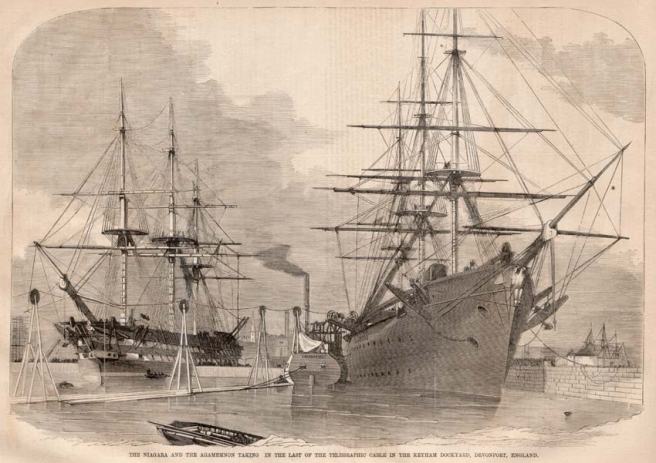
To make a reasonably-sized story short, Niagara and Agamemnon failed four times to lay the cable. Things like extreme storms and numerous cable breaks set the venture back time and time again. But Cyrus and his friends remained undaunted. In a move that would be hailed as the very definition of perseverance in the face of adversity, a fifth attempt to lay the cabling was made in July, 1858. By the beginning of August, it was completed successfully. Communication without the use of boats was now possible across the ocean. President James Buchanan and Queen Victoria even exchanged telegrams using the lines. Quite a historic moment. Hans Christian Andersen even wrote a fairy tale about it.
Now, thanks to a variety of factors, this cable was in service for less than a month. It was decommissioned and left unrepaired while engineers went back to the drawing board. This transatlantic telegraph had proved that the ocean was not an obstacle that could never be overcome. As long as the cables were strong enough, insulated enough, and powerful enough, the entire world could be connected to light-speed communication.
Let’s fast-forward a hundred years later. Ever since the early 19th century scientists had envisioned using light, instead of electricity, to send communication signals. As technology slowly improved over the decades, advancements were made that further encouraged researchers to look into finding a viable way to transmit data this way. In 1966 A team of British researchers at Standard Telecommunication Laboratories finally figured out that by using a very powerful laser and extremely pure glass thread, fiber optic technology was within humanity’s reach.
Fiber optics! Techopedia defines this miracle as “[T]he technology and medium used in the transmission of data as pulses of light through a strand or fiber medium made of glass or plastic…” Boiled down even simpler, thanks to those researchers, high speed communication via flashing lights was now proved to be possible. What does this have to do with underwater communication cables? Quite a lot. You see, fiber optic cables were developed soon after STL’s breakthrough, which are (you guessed it) extremely long tubes of glass that can transmit these pulses of light vast distances, nearly instantaneously. Now you see where we’re going with this. I could talk for a long time on fiber optics, but that would be more than enough material for another article.
Long before this tech had been developed, many underwater telegraphs were successfully laid thanks to the pioneering effort of the Newfoundland-Ireland line. Thus, once fiber optics were perfected to the degree that a single line could span hundreds of miles, it only made sense to piggy-back off of Morse and Gisbourne’s designs and use them to create a new way to transmit data. Of course, they would have to be carefully constructed to ensure they wouldn’t break in a month or two. Below is what modern fiber optic cables built to withstand the ocean look like.
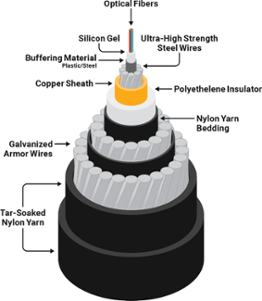
As you can see, the actual glass optical fibers are very small. A single strand is about the width of a hair. This allows for excellent flexibility – you wouldn’t want them cracking 27,000 feet below the surface. They still need quite a bit of protection, however. steel and copper sheathes surround the glass, with various materials insulating the line from the harsh ocean. Finally, several thick layers of specially crafted yarn form the outer shell of what is now a still pretty small cable. Considering that companies are paying for hundreds of thousands of feet of this cable, I’m sure they want them to be as small as possible to cut down on cost while still transmitting vast amounts of data at a high speed.
Today it is estimated that over 400 cables are lying underneath Earth’s oceans, spanning over half a million miles! If you want to see a really cool map of all the cables in existence today, look no further than submarinecablemap.com. This website is really, really great if you want a visualization of the vast effort that has been put into allowing you to read this article on your computer, phone, or tablet. If you think satellites were how you navigate the web, you were wrong. These babies are what handle the bulk of communication across the world. It’s truly an amazing thing. And to think it all started from the telegraph. In the span of less than 200 years we’ve taken our international communication methods from sending ships with letters to sending pulses of light over roads laid on the ocean floor.
I’ll leave you with a short, two-minute video from Business Insider that summarizes some of what I’ve talked about, as well as pointing out some interesting factoids about the process of laying down the cables. It’s a good, bite-sized chunk of information on a massive, astounding subject.
 Cineri Gloria Sera Venit