

My Year of Laffy Taffy: Days 8 – 14

Day 8

Strawberry. You know it, you love it, clearly I haven’t gotten enough of it. It seems to be the only flavor with the general consistency of something above 9 on the Mohs hardness scale. I shatter my teeth, fillings, and crowns for you, dear reader.

Q: What sport can also research?

A: Surfing

Immensely bad, heavily reliant on the reader not only understanding that “surfing” here is a shortened form of “surfing the internet” but also the implication that browsing the internet constitutes research. Not in 2025, Wonka – the general population uses the internet strictly for posting misinformation and racism.

Q: What color screams hello?

A: Yellow

This is a joke my mother would love – I think it qualifies as an anti-joke, or (to quote the late great Elizabeth Comstock) something so like it, I cannot tell the difference. It’s mildy amusing, perhaps, if you’re not expecting it and aren’t completely sober.

Day 9

It’s another random taffy kind of day, and that means more Sour Apple. After choking down the artificial taste, I instinctively threw the wrapper away in what I can only assume was a subconscious act of self-preservation, before remembering my purpose.

Q: Why did lunchtime speed by?

A: Because it was fast food.

Well I feel sorry for the individual who came up with this, because if they’re eating fast food for every lunch they’re in bigger trouble than if they ate Laffy Taffy every day for a year… Also the joke sucks.

Q: What’s a taco’s favorite dance?

A: Salsa

This marks the first time in this series that the answer occurred to me without me even needing to think. It avoids most of the pitfalls of its predecessors: bad grammar, nonsensical, stupid, but it falls into what is arguably the worst one just as it almost crosses the finish line: It’s just not funny. And that’s a crime that calls for the writer to pay the ultimate price.

Also salsa doesn’t go on tacos, so a -2 to its final score as well.

Day 10

For breakfast I enjoy some pliable gooey paste vaguely flavored like a toddler’s imagination of cherry, then immediately wash my mouth out and brush my teeth before returning to review the jokes.

Q: What has 2 hands but no arms?

A: A clock.

What kind of The Hobbit-ass riddle is this? The only way it could sound more dated if it was “Thirty white horse on a red hill”. This is the kind of joke Bilbo Baggins would tell at his going away party to make his neighbors hate him just a little more. This “joke” would have been old when ships were exclusively made out of wood. I think humans are born knowing the answer to this, but maybe once analog devices have vanished from this world the concept of clock hands will become forgotten knowledge…

Q: What building has the most stories?

A: A library.

This one… is all right. They got me right in the special interest, our delightful public library system. It’s a clever bit of wordplay subverting your expectation of the definition of the word “story” in the context of a building. It doesn’t make me laugh, but considering how low the bar is for a Laffy Taffy joke, I declare that it passes muster and the author may be spared during the coming joke war.

Day 11

I figured I should take pity on the noxious banana, and have another piece. After all, If I only eat the good flavors, then I’ll have 30 bananas to get through at the end of the container and my frail psyche couldn’t withstand such an attack.

Q: What’s a potato’s favorite game?

A: Hash-tag

Well, I certainly never would have come up with this answer. Honestly maybe one of my dear readers can explain this to me. An attempt to be a play on hash browns? Is there a similar synonym for potatoes I’m unaware of? Hash-bag? What on Earth is this tremendously bad joke? Who approved this?

Moving on.

Q: What can make honey and words?

A: A spelling bee

I wouldn’t be surprised if this was a reference to The Phantom Tollbooth’s Spelling Bee, and thus – while not amusing – this gets a pass.

Day 12

Why is the strawberry flavor so hard?!?! By the time I’m done it feels like my jaw has gone through a workout regimen that would put prime Arnold Schwarzenegger to shame.

Q: Who was responsible for the lake’s disarray?

A: The Loch Mess Monster

Another passable joke – a better synonym for “disarray” could probably have made the question flow a little better, but I do like the “mess” pun. No laugh but I did raise my eyebrows slightly at the unexpectedly decent joke.

Q: Why did the girl have a tiny wooden infant?

A: She wanted a whittle baby

It’s finally happened people – I smiled when I read this. And they said it would never come to pass. I could take umbrage with the cumbersome wording of the question, but that’s nitpicky stuff. “Whittle baby” is pretty good. So far, easily the best taffy wrapper I’ve read this year – but I’ve got so far to go, maybe this is a sign of better jokes to come.

Day 13

I’ve got the flu, and the last thing I want is to eat some Laffy Taffy. Hot tea and soup would hit the spot, but looks like I have no choice but to soldier on with my mission. And today, this brave warrior gets cherry. It’s soft, at least.

Q: Why did the phones break-up?

A: There was no connection.

Ah, so close to having something here. Not a joke, but it loses points for grammar. I wasn’t 100% sure but something about that hyphen bothered me. I went to Google and found this determination from Grammarist:

“Breakup is one word when it’s a noun (e.g., it was a bad breakup) or an adjective (I’m writing a breakup song). It’s two words (break up) when it functions as a verb (I think we should break up). Some publishers use the hyphenated break-up in place of the one-word form.

They could have gotten away with the hyphen IF it had been the noun usage, but alas – no points for almost using proper grammar. It’s the labor camps for the author, I’m afraid.

Q: Why did the cable get sad?

A: His phone friend went wireless.

Ok, ok – I spent the time I didn’t laugh trying to poke holes into the mechanics of this joke, but it turns out it actually makes a little sense. I initially thought “What on Earth is a ‘phone friend’ – Something akin to a pen pal, one you don’t know personally but speak to regularly on the phone?” But then I realized (giving the writer the benefit of the doubt here) that it could be that the cable had a literal phone as a friend, in which case all is right with the world. The cable is sad that he’s no longer connected to the phone, and thus – in this strange alternate reality of sentient wiring – can no longer communicate with it.

Day 14

Finishing off this second week of the ‘verse with banana. So far I have kept my flavor consumption rotated fairly – I absolutely must not get to the end of this tub with a huge amount of strawberry and banana ahead of me.

Line 1: This is a bad seaweed joke.

Line 2: Sorry, I just couldn’t kelp myself.

Tries to do something new – predictable, but new, for Laffy Taffy at least. The second line sounds like kelp could imply another word though. Kelp yourself – NOW!

Q: Where do cows write their secrets?

A: In their dairy.

A dyslexia joke! How droll. I wonder if we’ll get the “sold his soul to Santa” one. Probably not.


This has been January 8 – 14 of my journey through the Taffyverse. You can catch the rest of it in a chronological list over at the index.

My Year of Laffy Taffy: Days 2 – 7

Taffyverse days 2 - 7 thumbnail

Day 2

Strawberry. Hard as a rock. And here I had thought things would be smooth sailing. Instead, I nearly lost a filling.

Q: Why did the GPS coordinate get kicked out of class?

A: He had a bad latitude

This one is actually not awful. I’d even consider giving it the highest compliment a Laffy Taffy joke can receive: almost decent.

Q: What did the miner think about this joke?

A: He dug it.

This one is actually awful.

Day 3

Banana. What? There are only four flavors in this bucket, I didn’t want to be going back to apple again so soon, and I didn’t realize until day 5 that Strawberry and Cherry were different flavors here – their wrappers are identical in color. Anyway, my fans demand integrity and balance. And of course, this one was soft, supple, tantalizingly yielding under my tongue… *cough* maybe banana isn’t so bad after all…?

Q: What is free and full of teeth?

A: A smile

I kind of see where they were going with this at a wholesome angle, but it’s less a joke and more something a creepy man says to a woman on the subway.

Q: What shoe type can’t decide?

A: Flip Flops

Mmm I don’t have any notes for this one. It passes muster for Laffy Taffy. Interestingly, I have noticed they don’t put the name or age of the person who submitted the jokes on the wrapper anymore… I assume because no one submits them anymore and they’re stolen by the Wonka brand’s minions from 70 year old Bennett Cerf joke books.

Day 4

Well I had to pick a flavor I’ve had before now, sue me. This time it really was random though. Of course the fates have it out for me and it turned out to be banana. Again, at least it’s soft. Not a great desert today but I must have been a bad boy.

Q: How is a USB like an elephant?

A: They both have memory skills.

Another nonsensical one – USB isn’t inherently a storage device, it’s just an industry standard interface that allows data or power transfer. Even if the joke read “hard drive” instead of “USB”, drives don’t have memory skills. They have memory storage. I’d believe this one came from a five year-old – in the immortal words of that one VW commercial: “You get an F.”

Q: Why did the traffic light turn red?

A: It was embarrassing to change in the street.

All right, credit where credit is due. This one made the palest ghost of a shadow of a smile appear on my face. Or maybe it was a trick of the light.

Day 5

Lunchtime – what better to have than a healthy serving of apples? Something to keep the doctor away, which may be true, but certainly not the dentist. I can almost hear him rubbing his hands with glee as I peel back the wrapper…

Q: How is a bad joke like a broken pencil?

A: They have no point.

How is the joke above me like a broken pencil? It’s a bad joke.

Q: What did one eye say to the other?

A: Between us something smells

Another brainmelter. So many things wrong with this – grammatical structure, lack of a punchline, the implication that “between us something smells” is a common turn of phrase? This wrapper needs to be immolated in the fires of Mount Doom.

Day 6

As I crack into my first Cherry – now that I know it exists, and recall that it’s actually the best of the flavors – I can’t believe I committed to this for a year. Hopefully the taffy jokes really start stepping up and carrying these posts, because I don’t know if I can be non-repetitive enough in my excerpts to make 52 of these posts.

Q: What’s full of flowers but also a snake?

A: A garden.

This one perplexed me – and considering this is but one of several that have just this first week, I wonder… am I the stupid one? Am I unable to make heads or tails of these “jokes”? The wording of the question seemed to imply the answer would be “full of flowers” and also literally or figuratively “be” a snake. I was expecting something like “your mother-in-law” or similar type of play on words of snake, but perhaps the interpretation here is the garden is “full of flowers” (true) and “full of snake” (plausible, not guaranteed, snake should also have been plural). Garbage tier joke.

Q: What type of line is not spoken or drawn?

A: On-line.

I can’t do this. Laffy Taffy is a psy-op by the CIA to induce readers to suicide.

See you tomorrow.

Day 7

Mmm, cherry. So nice, had to have it twice – in a row. Let’s see if the jokes will be similarly tasty.

Q: What button can’t unbutton?

A: Your belly button.

Well, technically not true, but the truth might be a little too gory for a whimsical taffy wrapper.

Q: What 3 letters hold a lot of data?

Oh… no no no wait wait wait!

A panicked Punisher says "No No No Wait Wait Wait Wait" in this gif.

A: USB

And there it is. Another fundamental misunderstanding of USB. If you’re the kind of person who also doesn’t get the difference between the shapes of the connectors you plug into your phones/computers and the actual place data is stored, please avail yourself of the Wikipedia article on it. You might save a life when you send jokes to Laffy Taffy – mine.


This has been January 2 – 7 of my journey through the Taffyverse. You can catch the rest of it in a chronological list over at the index.

My Year of Laffy, or: How I Learned to Stop Worrying and Eat the Taffy

I’ve decided to do something new with this blog. While I do plan to release some new, typical blog post content this year, I’ve had an idea for an interesting bit floating around my brain for over five years. What if I consumed a piece of Laffy Taffy every day for a year straight, reviewing the jokes on the wrappers? Something no one asked for, no one wanted, just like me. I’ll consolidate these posts in a weekly format, but the first day deserves a special call-out.

Let’s dive in.

Day 1

I open the 145 piece tub of red 40, and probably 1 – 39 as well, and am immediately hit with a chemical smell of some kind of preservative. Formaldehyde, most likely, but I’ve always wanted to get a head-start on my embalming. After a year’s worth of Laffy Taffy, I’ll probably be pretty close to dead anyway.

Picking a piece completely at random, making sure it’s not banana, I select sour apple. If only there were more than four flavors in this container, and if only more than three of them were any good.

Joke 1

Q: What’s a baseball player in a hot air balloon?

A: Batter up.

At first I thought the grammar of this one seemed funky, but after some thought I realized it’s just an awful joke that my brain was trying to find some semblance of sense in. It technically works, linguistically speaking, but when you’re having to get into the technicalities of jokes, it’s already failed as a piece of humor.

Joke 2

Q: What do you call a clown with a psych degree?

A: A funcologist.

This one actually broke my brain. It appears the “funny” lies in the assumption that you can replace the “psych” in “psychologist” with any other word, even if it doesn’t rhyme or sound similar in any way. I imagine the punchline would have had exactly the same weight if it had been “a jestercologist” which is to say, none at all.

The hard part of my job for the day done, I ate the sour apple taffy. Softer than I was expecting, thankfully. Historically I’ve bought packages where only the banana had a consistency and temperature something north of an icicle, but we’re off to a good start here.

One day down. 364 to go.

It’s Time for Anatomy Class: The Utility Pole

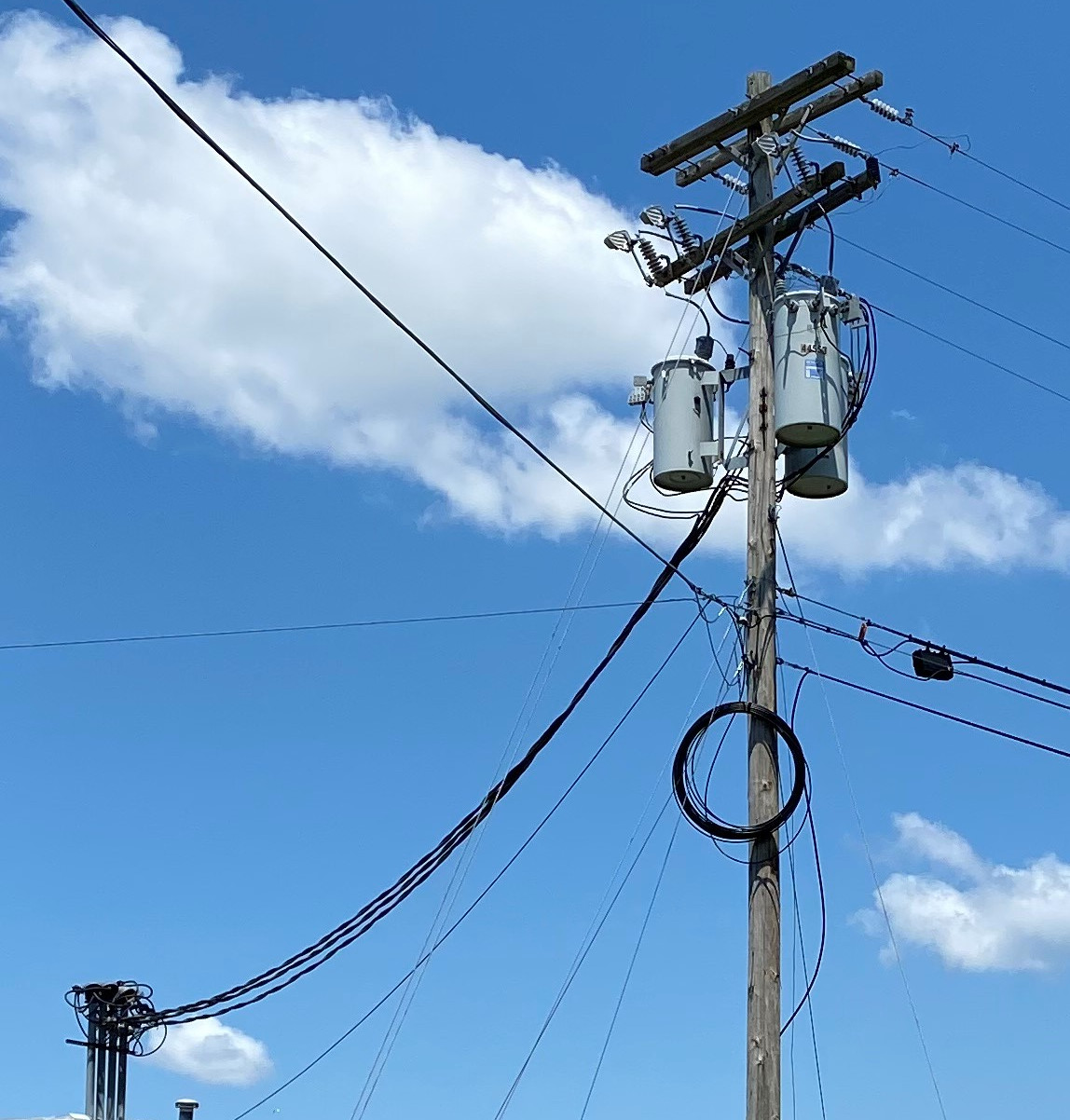
“Utility Pole, 1 of 3” by misternaxal

If you’re anything like me, you’ve driven, walked, flown over, circled around, narrowly avoided crashing into one of the most ubiquitous examples of modern engineering and convenience ever made: the telephone pole. Also known as a utility pole which is a more accurate name in the present day, as these tall wooden structures do a lot more these days than simply transmit communication signals from point A to point B. But while you vaguely know that these have something to do with how we are able to easily use the phone, have electrical appliances, and watch cable television, do you know what all those crazy looking metal bits and bobs and multiple wires all specifically do?

I didn’t until I finally decided to learn for myself, and soon enough, you’ll know too.

The more historically-minded among you can probably guess when and why the first telephone poles came into existence, and you might even know that they of course wouldn’t have been called telephone poles at all. Yes, their origins harken back to a time before telephones – or even any form of communication faster than “snail mail” – existed. At their debut in the mid-nineteenth century they were called telegraph poles, and were used by a variety of clever engineers (among them telegraph and Morse Code pioneer Samuel Morse, of course of course) to transmit text messages using electrical signals sent through extremely long wires. Funnily enough, the original plan for telegraph wires was for them to be buried underground, however thanks to some defective wire insulation accidentally sabotaging Morse’s planned demonstration for Congress he had to quickly come up with a plan B. This plan was to cheaply build a series of poles to string the telegraph wires along. The test was a historic success, and the fate of American railways, roads, and highways was sealed. Never again would a citizen be able to drive more than 100 feet on a road without seeing long cables stretching across the horizon.

Fast-forwarding to today, we no longer use the telegraph. However, the infrastructure built by the engineers of the past still remain, repurposed into the utility pole.

The modern utility pole is a 35 foot tall, 1 – 2 foot diameter cylinder usually made from decades old fir or pine trees. You may have seen some variants made from steel or even concrete, and possibly even very tall poles ranging up to 100 feet, but those are generally for more industrial, heavy duty power transport. The kind you see every day outside your home, workplace, or favorite shopping haunts are generally all the same imposing wooden posts, maybe adorned with some horizontal bars at the top.

But the interesting part of utility poles to me is not the poles themselves, but instead the things that are placed on the poles. Crazy steel spirals, big cylinders with small wires running off them, thick black tubes hanging off the sides… what do those all do?

Well let’s start at the top, because all the most fun (i.e. most dangerous) stuff is up there. This is by design – the most hazardous parts of the pole are kept as far from the ground – and potential human contact – as they can be. The upper part of the pole is called the supply space because that is where the electric supply lines live.

The horizontal bar at the top of some poles is called a cross arm. These arms support several large wires called primary lines. Primary lines are the workhorses of the electrical supply – they carry power at blisteringly high voltage – anywhere from 4,000 to 34,000 volts. They are usually made out of copper, or else steel encased in highly conductive aluminum (source).

Underneath that on many poles is a thick cylinder called a transformer, which has one very simple but important function. It converts the crazy high voltage electricity carried by the primary lines into much more manageable voltage, the kind our appliances and electronics like to use. A transformer is required any time the power needs to get off the pole and into a house or business. Sometimes a transformer will lower the voltage and then send it over many utility poles which do not have primary wires – you’ll see these often in residential areas, connected to every house. This requires a second set of low voltage wires that you’ll typically see underneath the transformers – aptly named secondary lines. These wires carry voltages between 120 and 280 volts – much smaller than primaries. Mixed in with the secondary lines is a grounded neutral conductor line to provide path for the electricity to return to the power station.

The transformers also have cool little things attached to them called lightning or surge arresters. These things are basically powerful surge protectors that prevent massive influxes of power from overloading the transformers – the kind caused by unlucky lightning strikes or even the transformer hardware going haywire.

They are designed to divert power surges into the ground rather than the transformer, thus preventing it from damage while also keeping the power levels going to your home or workplace constant. That means less chance of a power outage! Here is a cool video I found that explains a little more in detail exactly how an arrester works, and what’s inside that mysterious stacked disc shape.

Underneath the secondary lines is where the telephone and cable wires go. These are far less dangerous than the electrical wires above and therefore they do not reside in the supply space – they inhabit their own area called the communications space. These don’t pose much of a threat to people – if you touched one while also being grounded, it wouldn’t be enough to seriously injure you. These cables usually only have around 50 volts running through them. Here is a link to a simple interactive diagram that show the separation of the sections of a utility pole.

Hanging on all these wires are black boxy objects. These are easy to explain: The cables carried by telephone poles are not infinitely long – or actually very long at all when compared to the length they need to be to run across towns, cities, and states. Multiple rolls of cable need to be spliced together in order to function as a single continuous wire. These black boxes are weatherproof enclosures that house the numerous cables and wires at their terminating point, providing a central location for joining a new roll of cabling to others, while allowing easy access for repairs and adding new splices if necessary.

Now for the very bottom! One of the most common parts of a telephone pole is a wire coming off it at about 60 degree angle, sometimes covered in a distinctive yellow jacket. For the longest time I thought it was a ground wire, to direct any excess electricity down safely into the ground instead of into an unsuspecting animal or human that might accidentally touch it. That ground wire does exist, however it is a thin wire than is directly attached to, and runs down the entire length of, the telephone pole. So what is this other cable then?

It’s known as a guy wire and its sole purpose is providing additional support for the utility pole. It helps keep the pole – which is also set six feet into the ground – upright during high winds. That’s all! It’s not energized and isn’t used for conducting electricity. The yellow plastic that surrounds it is primarily for visibility, to ensure people don’t walk or cycle into it. However, there have been cases where the ground wire wasn’t properly grounded, and thus the guy wire became the path of least resistance for excess charges, resulting in human injury, so… in the end, like everything on a utility pole, it’s best to leave the guy wires alone.

That wraps up our anatomy lesson! After years of being curious about the elements that make up telephone poles I finally dug into them, and I’m glad I did. It’s amazing to me how these ex-trees so quickly dominated our landscape, and how essential they now are to our lives. I don’t consider them an eyesore like many do, though I can’t help but wonder if things would be different had Samuel Morse been able to prove the viability of underground wires when this technology was just beginning to appear…

###

Hungry for more information on utility poles? Check out this great PDF made by American Electric Power that presents the sections in a visual, easily digestible format!

FFITHW: A History of the Scheme

Pernicious plans devised by devious dastards? Not at all- the scheme we’re talking about is one you see every day. Behold!

URL_Example

The circled part is known as the scheme. This particular scheme stands for Hypertest Transfer Protocol Secure, a more secure way to send information than the plain old HTTP we knew and loved. Have you ever wondered why it appears at the forefront of all your web pages, even when the iconic ‘www’ is omitted? And what on earth is the deal with those slashes?

Those questions can be, and have been, answered by the literal creator of the internet. No, not Al Gore. That honor belongs to Sir Tim Berners-Lee, and he was the one who decided the majority of the internet naming conventions we still use to this day.

Sir Tim Berners-Lee was the engineer who was first able to execute the creation of a worldwide file sharing system, and his long career could probably have its own post. While designing the syntax of web URIs (Uniform Resource Identifier), he copied the file structure used by a computer company called Apollo. They used a double slash to indicate a network path, which he then used to separate the web domain from the transfer protocol servers ask the client computer for (HTTP).

The colon is a modifier that specifies what server port your computer needs to talk to. It’s often left blank as the ‘HTTP’ part already has a default port which is what’s used. It shouldn’t really even need to be there. The use of the colon and file hierarchy is explained in much more technical terms in a paper Tim wrote on URI syntax.

Basically, the format of the scheme exists because it was cobbled together from old naming conventions and perhaps a lack of understanding of how well-used (and scrutinized) his system would become. Amusingly, Tim regrets his decision to structure the internet this way. He believes that it is unnecessarily complicated and given the chance to do it again, he would redesign URIs, remove the ‘www’, and yes, even take away the double slash we’ve known for so long. Alas, it’s too late for him to change his creation any longer.

Tim_Berners-Lee
“The internet was a mistake” – TimBL, probably

Guest Post: Ideation: A How To

Another guest post from the esteemed writer Athena’s Quill. if you are struggling to come up with ideas for any projects going on in your life – this is for you.

Ideas: Not always easy to come up with.

“Ideation.”

That’s a new word (and by that I mean it’s fewer than 200 years old). I’ll spare you the dictionary definition because it’s just what it sounds like: getting/making/finding ideas.

We all want good ideas, lots and lots of them. (If we had more good ideas, we would want money a lot less, for sure…) I pick up tips everywhere I can in order to generate good ideas, and so far I have a few favorites. So, in order to get more good ideas for your daily routine, your creative project, or your puzzling problems, run your topic through this list of idea sparkers and get some good stuff going.

First of all: Before you come up with good ideas, you need to come up with ideas. Those of you who feel like your ideas are usually lame and bad: the following is a tip I love almost as much as my little brother.

  1. Pick a number between ten and twenty.
  2. Make that many bullet dots on a page.
  3. Resolve not to give up or get up until you have an idea for every dot, even down to “Rob a bank in my pajamas in broad daylight with a squirt gun.”

Okay, while you will laugh at some of these things, what you now have before you is a really great thing: a list of lots of ideas! Some of them are going to be pretty workable, and some just need tiny tweaks before they could be usable too. And those weird ones? They’ve helped you already. As you’ve been generating weird stuff to get all the blanks filled in, you have been thinking creatively, forcing your brain to make unusual connections. Doing this primes you for even more generative thinking in the next few days. Although it might seem strange at first, know that I use this method of quota idea generating successfully for things like new menu ideas, writing topics, where to go and what to do on the weekend…just about everything!

Another thing I like to do is use “all the brains I can borrow” like Woodrow Wilson said he did. brainWhen I’m puzzling something out and looking for new ideas, I send a text message out to everyone I’m on speaking terms with (or I actually call them, if they are older than I am). In this way Other People do the thinking for me and then I get to sit back, selecting and rejecting as I like, chuckling with the feeling of great power. Seriously, though, this is an important thing to do to for ideas because we need to get out of our own heads when we’re stuck. Other minds help us do that. And even if none of the suggestions you get actually work out, your mind will at least be nudged in new directions and will get you moving closer towards a workable idea.

Writers–you’ll get my next piece of advice write away: to get some fantastic ideas for your project, draft right now, as quickly as possible. All you other kinds of artists and idea hunters—do exactly the same thing with your work and/or problems. Whatever your project: sketch a preliminary mock-up, jot down the first notes of a song you’ve been thinking of, make a preliminary to-do list, right after you finish reading this. Whatever it is you’re planning to do, get it out of your head right now. It might seem embarrassing, what you have just produced, but this is the part where you get to make the magic happen. With this draft, you now have time to let it sit by itself for awhile. While it’s sitting around, your mind has now turned into a conduit for amazing ideas for this project: what to do to make it better, great things to add on, things you can cut, how you can present something more clearly…You will be absolutely amazed at the great ideas that come to you only when you have made a first draft your creation. Where were they when you began to write/paint/compose? I don’t know, but draft quickly to get amazing ideas to come to you quickly. [Blogger’s Note: This method has helped me more times than I can count.]

For great ideas for going projects, have yourself do a tiny bit of the above every day. Draft a sentence, sketch a detail, add an idea to a recipe, to your project every day. In a week you will be surprised and thrilled with what you have accomplished, and again, you will become and idea magnet for you art.

Beyond the obvious one–“Does this project need to be done at all?”–it’s important to challenge assumptions to generate good ideas for your problems and projects. Think of what you’re currently looking for ideas for, and ask these questions about it out loud to yourself, “Do I need to do it a certain way, at a certain time, in a certain place? Does it have to be a certain size, length, color? Can I do it for free? Can somebody else do some of it?” Examine other assumptions you may have made. (By the way, the false assumptions can often be found under the parts of the problem or project that make you groan or dread it.) Bust them wide open, and better ideas for things will occur to you.

justdoit

All of the above are ways I figure out what to write blog posts about, including this one right here. I promise you these tips really work. I hope you will give them a try and see if they work as well for you. Your life is your greatest project, and good ideas will make it a more fun adventure. Good luck generating ideas, and congratulations in advance!

Moons – We’ve Got a Lot


351_earthise_old_new_1200
First Lunar Earthrise, by NASA/Ames Research Center/Lunar Orbiter Image Recovery Project

Recently, in my trawls across the vast ocean we call the internet, I came across something actually interesting from National Geographic. I know, I thought they ceased to exist when people stopped collecting their drab yellow magazines as well.

It was a beautifully crafted site that slowed the processor of my aged laptop that I first tried to view it on to a crawl. After retiring to my study and firing up my somewhat beefier desktop, I was greeted by the sight of over 200 objects that orbit the planets in our solar system. Yes, dear reader. I’m talking about moons.

Too see what I’m talking about instead of having me recite the contents of the web page to you, click the following link:

https://www.nationalgeographic.com/science/2019/07/the-atlas-of-moons/

The moons of all nine planets (Pluto, are you back in??) are available for your viewing pleasure, though not all the planets have moons. Mercury and Venus do not have any moons at all, though their embarrassing lack of orbiting space rocks is more than made up for by behemoths like Jupiter and Saturn, who have 79 and 82 respectively. Interestingly, the Earth is the only planet with a single moon. I think it would be pretty cool if we had two, like less bright suns of Tatooine from Star Wars, but I suppose it’s better than none at all.

Scrolling down through the site allows you to view each planetary system in detail, beginning with Earth. Visual representations of moons revolving their planets appear interspersed with miscellaneous trivia you can use to impress, or bore, your friends. You can even view fully manipulable 3D images of the moons, allowing you to see every crater and mountain in detail.

There’s a lot of fascinating info there, the site is truly a work of art. It really makes you feel how truly vast the planets and their moons can be. The ability to superimpose the USA onto the moons to realize their scale is a nice touch. Europeans, sorry. No frame of reference for you.

After viewing your moon of choice, and if you’re like me you’ll choose a lot of them, Nat Geo puts some tags that relate to some unique traits of the moon. For example our moon has “Odd Composition”, “Odd Origins”, and “Atmosphere”. Clicking on these will show other moons in the solar system that have those traits. I didn’t know our moon had an atmosphere, assuming that it simply floated like an oversized arrogant asteroid in space, but that’s not the case. Not all moons have one, of course. Why? Well, that could be a blog post all on its own.

Another cool thing they’ve got is an infographic on the various moon landings that have happened, telling you dates, country of origin, and whether or not the spacecraft was manned or not. The moons of planets besides Earth have no manned landings, yet. Fingers crossed for a trip to another one so that Matthew McConaughey can be relevant again in a much-anticipated Interstellar 2.


Mars_Phobos
One such potato, a render of Phobos by National Geographic

Continuing the perusal of the site leads you to Mars and its two moons, and so on and so forth. Interestingly, the moons of Mars (and many other planets) are not spherical in shape at all, instead looking more like asteroids, or as Nat Geo describes, “ruddy space potatoes.” Seems a little harsh. I mean, they aren’t wrong, but moons have feelings too!

Scrolling through Jupiter is fascinating as you get to see the orbit of every one of its 79 moons (four major, seventy-five minor). The overall chart looks like some kind of demented scribble with ovular orbit paths overlapping endlessly over one another. It’s apparent astronomers just kind of gave up on naming the moons, since some have sweet monikers like Harpalike, Thelxinoe, and Euthanes, and then you run into a stream of ones called things like S/2003 J 18. Don’t worry, there are only in-depth infographics on the major moons, so you don’t have to scroll through a wack list of identical, boring semi-asteroids that got lucky enough to orbit instead of crashing into a planet’s surface.

The site continues in this manner, highlighting points of interest about the various moons and providing additional background information on how we suspect they were formed, how old they are, etc. All in all it was a pretty entertaining half hour journey, being the moderately curious person that I am, and it was cool to get to take a closer look at the more overlooked celestial bodies of our solar system. Please, check the site out yourself and let me know some of the interesting things you learned about moons!

As a farewell, here is a bonus, super HD gif of a full rotation of Earth’s very own, incredibly lazily-named moon: The Moon.

https://gfycat.com/perfecthoarsedobermanpinscher


The Undersea Freeway

Have you ever wondered what it would be like if a road existed that spanned the entire Atlantic ocean? A way to get to Japan from the state of Washington? What about a direct path from California to Australia, South Africa to Brazil, or even Florida to Spain?

The cost would be immense, wouldn’t it? After all, those places are all separated by vast oceans, thousands of miles of deep, treacherous waters. Physically connecting those places would be expensive, impractical, and not worth the difficulty when alternatives like flying and sailing exist. But… what if I told you those roads already exist? That they have been working and operational since the 19th century? That routes between those places and many, many more are the reason you are able to communicate with countless people all over the world, and may in fact be the reason you are able to view this post right now?

Well I am telling you that, and I’ll stop asking questions meant to draw you into this post. Now these roads might not look like you would imagine. Nor do they allow humans to travel over them – not physically anyway. Nevertheless, they are very real and do physically connect many parts of the world in a way that nothing else can.

It all began in 1858 when a cable was laid on the ocean floor that would become the foundation of a network spanning over 500,000 miles of physical, underwater cables. The tale of how this cable came to be born, live, and die is quite an interesting one, which you can read about here (for the modern summary) and here (for the original series of newspaper articles on it from the 1800s). Or you can ignore both of those and read my retelling here.

 After Samuel Morse’s brilliant invention of the telegraph had taken the world by storm and would be known as the greatest human advancement until sliced bread came around, an entrepreneur named Cyrus Field decided that the technology could be pushed further.

CyrusField
Cyrus – Millionaire, dreamer, ladykiller

The guy had retired at 34 with over 7 million dollars (2018, adjusted for inflation) so he clearly had a lot of free time to invest in pet projects. A Canadian engineer by the name of Frederick Gisbourne came to him, seeking an investment for a dream. Frederick had taken a look at the 20,000+ miles of telegraph lines spanning the United States of America and thought: “That’s cool, but what if we took these cables…. and put them underwater?”

Now Frederick had put his underwater cable theory into practice a few years earlier, connecting Prince Edward Island and New Brunswick. But this undertaking would have a vastly greater scope and significance. Instead of ~10 miles of underwater cable connecting two parts of a single country, his new idea was to connect Newfoundland, New York, and Ireland in a venture which would spawn the first continuous line of communication between countries separated by ocean. These locations were chosen because of a narrow plateau that existed between Ireland and Canada which would make laying the cable as well as maintenance slightly easier.

Cyrus and friends secured the aid of British investors, and together plans were made for this historic cable’s creation. The original attempt to lay the telegraph line was carried out by two ships, the American frigate Niagara and British warship Agamemnon. Both were loaded with over 1,000 tons of cable and sent on their merry way to the center of the Atlantic Ocean.

TransatlanticCableShips
The ladies Niagara and Agamemnon. Source: Frank Leslie’s Illustrated Newspaper, 1858

To make a reasonably-sized story short, Niagara and Agamemnon failed four times to lay the cable. Things like extreme storms and numerous cable breaks set the venture back time and time again. But Cyrus and his friends remained undaunted. In a move that would be hailed as the very definition of perseverance in the face of adversity, a fifth attempt to lay the cabling was made in July, 1858. By the beginning of August, it was completed successfully. Communication without the use of boats was now possible across the ocean. President James Buchanan and Queen Victoria even exchanged telegrams using the lines. Quite a historic moment. Hans Christian Andersen even wrote a fairy tale about it.

Now, thanks to a variety of factors, this cable was in service for less than a month. It was decommissioned and left unrepaired while engineers went back to the drawing board.  This transatlantic telegraph had proved that the ocean was not an obstacle that could never be overcome. As long as the cables were strong enough, insulated enough, and powerful enough, the entire world could be connected to light-speed communication.

Let’s fast-forward a hundred years later. Ever since the early 19th century scientists had envisioned using light, instead of electricity, to send communication signals. As technology slowly improved over the decades, advancements were made that further encouraged researchers to look into finding a viable way to transmit data this way. In 1966 A team of British researchers at Standard Telecommunication Laboratories finally figured out that by using a very powerful laser and extremely pure glass thread, fiber optic technology was within humanity’s reach.

Fiber optics! Techopedia defines this miracle as “[T]he technology and medium used in the transmission of data as pulses of light through a strand or fiber medium made of glass or plastic…” Boiled down even simpler, thanks to those researchers, high speed communication via flashing lights was now proved to be possible. What does this have to do with underwater communication cables? Quite a lot. You see, fiber optic cables were developed soon after STL’s breakthrough, which are (you guessed it) extremely long tubes of glass that can transmit these pulses of light vast distances, nearly instantaneously. Now you see where we’re going with this. I could talk for a long time on fiber optics, but that would be more than enough material for another article.

Long before this tech had been developed, many underwater telegraphs were successfully laid thanks to the pioneering effort of the Newfoundland-Ireland line. Thus, once fiber optics were perfected to the degree that a single line could span hundreds of miles, it only made sense to piggy-back off of Morse and Gisbourne’s designs and use them to create a new way to transmit data. Of course, they would have to be carefully constructed to ensure they wouldn’t break in a month or two. Below is what modern fiber optic cables built to withstand the ocean look like.

FIberOpticCableInside
Source: Telegeography.com

As you can see, the actual glass optical fibers are very small. A single strand is about the width of a hair. This allows for excellent flexibility – you wouldn’t want them cracking 27,000 feet below the surface. They still need quite a bit of protection, however. steel and copper sheathes surround the glass, with various materials insulating the line from the harsh ocean. Finally, several thick layers of specially crafted yarn form the outer shell of what is now a still pretty small cable. Considering that companies are paying for hundreds of thousands of feet of this cable, I’m sure they want them to be as small as possible to cut down on cost while still transmitting vast amounts of data at a high speed.

Today it is estimated that over 400 cables are lying underneath Earth’s oceans, spanning over half a million miles! If you want to see a really cool map of all the cables in existence today, look no further than submarinecablemap.com. This website is really, really great if you want a visualization of the vast effort that has been put into allowing you to read this article on your computer, phone, or tablet. If you think satellites were how you navigate the web, you were wrong. These babies are what handle the bulk of communication across the world. It’s truly an amazing thing. And to think it all started from the telegraph. In the span of less than 200 years we’ve taken our international communication methods from sending ships with letters to sending pulses of light over roads laid on the ocean floor.

I’ll leave you with a short, two-minute video from Business Insider that summarizes some of what I’ve talked about, as well as pointing out some interesting factoids about the process of laying down the cables. It’s a good, bite-sized chunk of information on a massive, astounding subject.